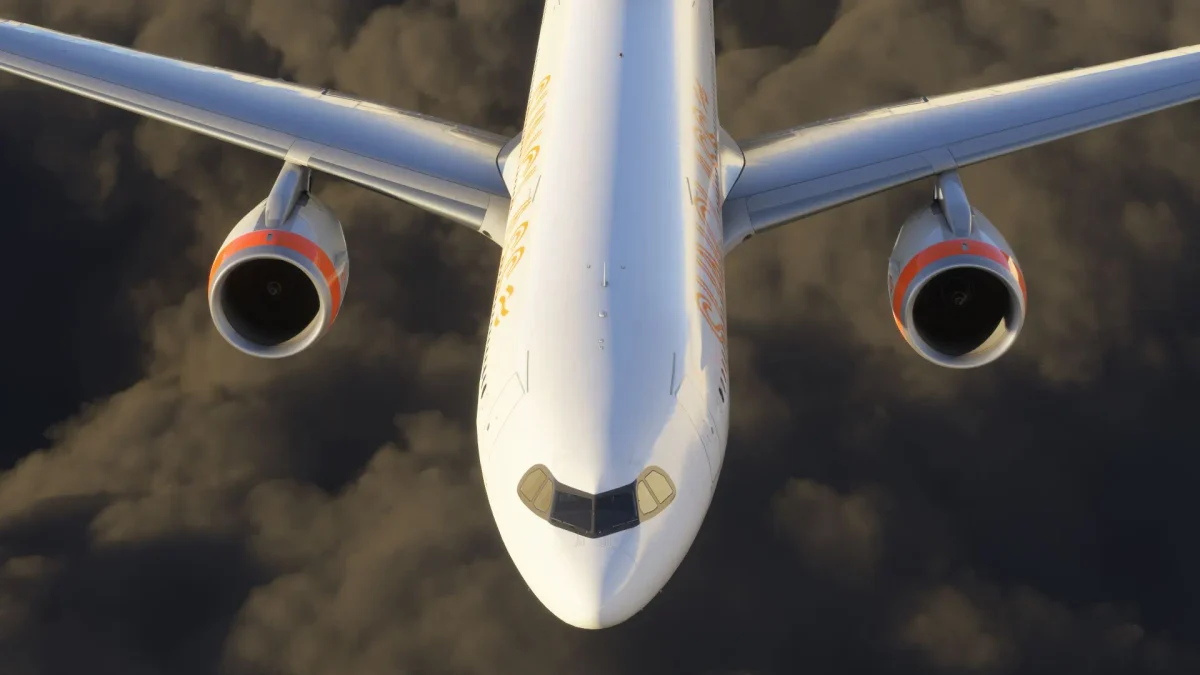








The iniBuilds A350 has just received what may be its most comprehensive update to date. Version 1.0.9 is now available for Microsoft Flight Simulator 2020 and 2024, and according to the developer, it brings major improvements across nearly every part of the aircraft—from navigation and systems logic to visuals, sounds, and performance.
At the core of this update is a complete rewrite of the aircraft’s VNAV system, a long-requested change among simmers. VNAV behavior in earlier versions was often unpredictable, especially during complex climb and descent phases. iniBuilds now says that VNAV should more accurately follow vertical profiles, respecting speed and altitude constraints, and avoiding common pitfalls like skipping restrictions during turns or failing to level off when required.

Beyond fixing existing logic, the update introduces several long-haul features that aim to replicate real-world airline procedures more closely:
- Estimated Take-Off Time (ETT): This reference time is now used during preflight to improve the accuracy of predictions in the flight plan. Once the takeoff phase begins, the FMS transitions from ETT to actual aircraft time.
- Constant Mach Segment (CMS): Pilots can now define a cruise segment between two waypoints during which the aircraft maintains a specific Mach number. This is especially useful for transatlantic flights along North Atlantic Tracks (NATs), where fuel efficiency and time planning are critical. Activation is done through the VERT REV page in the FMS by entering a start waypoint, target Mach, and end waypoint.
- Continuous Descent Approach (CDA): CDA generates pseudo-waypoints in the descent phase for deceleration and flap configuration, aiming to minimize level segments and use idle thrust as much as possible. iniBuilds says this feature provides more realistic vertical guidance to achieve a fully configured approach at 1000 feet AGL.
Together, these tools are intended to make long-haul operations in the A350 not only more accurate but also more manageable, especially for simmers flying complex routes and STARs.

Outside of navigation, version 1.0.9 brings a range of visual and environmental improvements. One of the most noticeable is the addition of dynamic icing and snow accumulation, with visual buildup on wings, fuselage, and stabilizers depending on weather conditions. In MSFS 2024, a snow layer can also form over the aircraft if it spawns cold and dark in snowy weather, slowly melting as the aircraft powers on. GSX integration is included for ground-based de-icing operations.
Brake systems have also received some attention, with the addition of hot brake disc visuals. iniBuilds says discs will now glow red and emit smoke when brake temperatures exceed 350°C—useful for those simulating heavy landings or rejected takeoffs.

The flight model has been refined as well. Yaw damping has been increased to reduce adverse yaw, and pitch control logic during rotation has been reworked to address previously reported overcorrections during takeoff. iniBuilds notes improvements in crosswind handling and a more realistic blend to pitch rate during rotation.
A significant audio update rounds out the feature list. Engine sounds, cabin ambience, reverse thrust noise, and touchdown effects have all been updated, with improvements noted in both MSFS 2020 and 2024 versions. iniBuilds says these changes help bring the soundscape more in line with the real aircraft.
Behind the scenes, performance has also been addressed. Code cleanup and optimization are said to reduce system overhead and improve stability. The changelog includes hundreds of entries, covering system fixes, autopilot logic, display formatting, ECAM behavior, and much more.