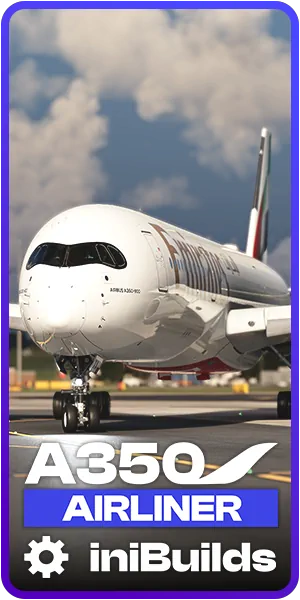






With the release of iniBuilds’ Airbus A350 for Microsoft Flight Simulator just around the corner, we had the opportunity to sit down with Jörg Neumann, Head of Microsoft Flight Simulator, and Ubaid Mussa, CEO of iniBuilds, to discuss the aircraft, its role in MSFS 2024, and the future of high-fidelity airliners in the sim.
The Microsoft Flight Simulator ecosystem is undergoing a major shift, with the impending arrival of Sim Update 1 and the MSFS 2024 Marketplace roughly coinciding with the launch of the A350. This marks a pivotal moment for both iniBuilds and Microsoft—one further solidifying its position as a leading developer of complex airliners, while the other looks to regain trust following the turbulent launch of MSFS 2024 last November.
To explore these developments, I spoke with Jörg and Ubaid about the evolving partnership between iniBuilds and Microsoft, the impact of the new Marketplace, and what simmers can expect from the A350, which iniBuilds describes as its most ambitious airliner to date.
Beyond this release, we also discussed the future of high-fidelity airliners in MSFS, how real-world pilot input has shaped iniBuilds’ aircraft, and Microsoft’s long-term vision for Microsoft Flight Simulator as a cutting-edge simulation platform.
Here’s what they had to say. The following is our full discussion, lightly edited for clarity and flow.
Vasco (MSFS Addons): Jorg, Ubaid—thank you both for taking the time to chat today. I want to start with something a bit intriguing, because Microsoft and iniBuilds have worked together on first-party aircraft before, but the A350 is a third-party release from iniBuilds. So, what’s the dynamic here? Is there a closer partnership between iniBuilds and Microsoft for this project?
Jorg Neumann (Head of Microsoft Flight Simulator): Honestly, I’m genuinely super excited for the A350. I think it’s one of the best things ever, and I mean that. It just so happens that it’s coming to the Marketplace at the same time that the Marketplace itself is evolving, as you know. So, this feels like the right moment to celebrate that—a third-party developer has done something fantastic. And I think it helps move the hobby forward. If I can highlight progress in the sim community, I’m all for it.
Ubaid Mussa (CEO of iniBuilds): Jörg has always been really supportive—not just on first-party projects but across many of his streams and other platforms. He always acknowledges the creative community. We appreciate the support he gives us, but he also uplifts many other developers. It’s great to see our work making an impact on the platform itself, helping improve the ecosystem.
Because at the end of the day, without a strong platform like Microsoft Flight Simulator, we wouldn’t be able to do what we do. So, I think it’s a win-win for everyone.
“The A350 is setting a new benchmark. From what I’ve seen, it’s truly something special.” — Jörg Neumann
Jorg: Our relationship goes way back. If I can share a funny story—at some point, I read somewhere that the Beluga was coming. I was so excited! I thought, “Oh, awesome, the Beluga is coming!”
Then Ubaid sent me an email saying, “It’s coming, but not to MSFS 2020.” (laughs)
I got ahead of myself. But that conversation actually led to the A310, which, for me, was a milestone. The A310 in the 40th Anniversary Edition changed my perspective on how we should approach aircraft in the sim. Because realistically, we could never achieve the level of detail iniBuilds brings with just the base sim alone.
With MSFS 2020, we had about 30 aircraft—some great, some less so. But it became clear that external teams were the way forward, and honestly, iniBuilds played a big role in shaping that direction. That’s why, for MSFS 2024, most of the aircraft have been developed by external teams.
And I think the A350 is setting a new benchmark. From what I’ve seen, it’s truly something special.
Vasco: So, should we expect the A350 to be a day-one release on the new MSFS 2024 Marketplace?
Ubaid: As soon as the Marketplace is ready, we hope the A350 will be there.
Jorg: The Marketplace in MSFS 2024 is tied to Sim Update 1, and Sim Update 1 is a complex process. We’ve been working on it for a while. The challenge is that every update has to go through certification. If an issue is found, we get an email saying, “Hey, something needs fixing,” and then we have to submit another build.
So, we don’t have a 100% confirmed release date for the new Marketplace because of that process. But regardless, the A350 will be available in the MSFS 2020 Marketplace, on the iniBuilds website, and all the usual places.
Vasco: I was wondering if we could see both things happening this week since the A350 is supposed to launch this week…
Jorg: That’s the goal. But, you know, I always ask this question—what’s more important, release date or stability?
Vasco: Stability, of course…
Jorg: Exactly. So, if certification finds something, we’ll take the time to fix it. We’re fairly confident—it’s been tested by around 30,000 people—but you never know. Certification is a rigorous process. If something comes up, we’ll spend another week to make sure everything is solid.
“Our team is made up of both pilots and programmers, working together from the start.” — Ubaid Mussa
Vasco: Okay, shifting focus to the A350 itself—this is, I believe, the most ambitious aircraft iniBuilds has developed so far. Ubaid, you’ve highlighted the involvement of real-world pilots in its development. How would you say working with those pilots has impacted the final product compared to previous airliners you’ve built?
Ubaid: I think our development approach has always been a bit different. Our team is made up of both pilots and programmers, working together from the start. When we develop aircraft systems, pilots and programmers sit side by side, testing things in real-time.
Many other companies follow a sequential process—development first, then testing. We test as we go, which has been our philosophy since the A310 for MSFS 40th Anniversary and all the airliners we’ve worked on for MSFS 2024. Having pilots involved from day one prevents late-stage adjustments that could have been avoided earlier.
The A350 follows that same principle. Some of the pilots who helped us with the A330 for MSFS 2024 also contributed to the A350, since the two share a common type rating. A real-world A330 pilot can transition to the A350 with the same type rating.
It’s fascinating how Airbus designs aircraft for cross-compatibility. A pilot could fly an A330 one day and an A350 the next, thanks to their shared systems and cockpit layout. That’s been an advantage in development.
But the A350 is still incredibly complex. Despite being over a decade old, it incorporates a lot of cutting-edge technology that isn’t present in older Airbus aircraft. That’s made it a challenge.
And MSFS 2024 has been crucial in helping us build this aircraft to a high standard. The new sim brings many benefits—faster build times for developers, faster loading times for testers, and even technical improvements like the new LOD (Level of Detail) system for sim objects. That’s what allowed us to create such a detailed cabin.
Previously, achieving this level of detail wasn’t possible. But with MSFS 2024, our team has been able to push boundaries in ways we never could before.
Vasco: Even with all this complexity and depth, do you think the A350 could be an interesting entry point for general aviation pilots looking to transition to airliners?
Ubaid: Absolutely. Microsoft Flight Simulator is the first sim to offer comprehensive checklist features and automated system completions. We started implementing these aids with the Airbus aircraft we collaborated on, and they’ve made a huge difference.
Many pilots find airliners intimidating at first, but the built-in aids—like auto-complete checklists—help lower the barrier. And you won’t find this level of assistance anywhere else.
So yes, I definitely think that even those who usually fly GA aircraft, but want to challenge themselves with an airliner, can use these features to make the transition easier.
“Right now, Career Mode accounts for about 56% of all time spent in Flight Simulator 2024.” — Jörg Neumann
Vasco: Will the A350 be available in Career Mode?
Jorg: Actually, that’s a great question. The goal of Career Mode has always been to keep it open-ended.
It’s really up to developers like iniBuilds to decide where their aircraft should appear. The SDK, now more comprehensive than at launch, explains exactly what needs to be done to integrate an aircraft into Career Mode. I often remind Asobo that it’s not about where our designers think a plane should go—it should be up to the creators who built it.
Ubaid: Yeah, absolutely. Flight Simulator 2024 brings a whole range of new features. One of my personal favorites is the exterior walk-around elements—you can now inspect the aircraft in incredible detail like never before.
As MSFS 2024 continues to evolve, we definitely plan to add more functionality. The release this week is just the beginning. We have the ULR (Ultra Long Range) update coming soon, which will introduce even more features.
And we’ve already worked on Career Mode elements. As Career Mode develops, we want to make sure our aircraft can take full advantage of it. As you mentioned, Jörg, Career Mode is becoming more and more popular. It’s extremely popular. So if the demand is there, we’ll absolutely support it.
Jorg: I was just looking at the data. Right now, Career Mode accounts for about 56% of all time spent in Flight Simulator 2024. That’s more than Free Flight, which honestly surprises me. When we were initially forecasting, we expected Career Mode to take up around 30% of total playtime—but it’s at 56% right now. That’s crazy.
Vasco: Ubaid, at this point, iniBuilds has developed and released nearly the entire Airbus lineup for Microsoft Flight Simulator. I know you have a large team, but do you ever worry that you’re stretching too thin across so many aircraft—both in active development and ongoing support?
Ubaid: You know, there’s a saying—the master of everything is the master of nothing. There’s a perception that iniBuilds only does one thing, but that’s not the case. Within iniBuilds, we have a dedicated aircraft team and a separate scenery team. The scenery team focuses entirely on airports and environments, while the aircraft team is divided into specialized sub-teams.
For example, the A350 was developed primarily by our airliner team. But within that group, we have teams with different expertise. Some specialize in general aviation aircraft. Others focus on warbirds and vintage planes. Then there are those who enjoy working on more unconventional aircraft—planes that are hard to find data on or present a unique technical challenge. And, of course, we have the airliner team that works on complex commercial jets.
So while iniBuilds is widely known for our airliners, we actually have a diverse range of expertise. And I firmly believe that creativity can’t be forced. Whether it’s aircraft systems, art, or technical development, passion plays a huge role.
I know some people assume we operate like an assembly line, churning out products, but that’s not the case. Every project involves a lot of enthusiasm, deep knowledge, and love for aviation.
Vasco: So, what comes next? We already know you’re working on the A380, but with Airbus mostly covered, what are your future plans?
Ubaid: We have other teams working on some really exciting projects. We’re discussing moving into different types of aircraft—maybe some business jets, maybe airliners from different manufacturers. But we’ll always focus on projects that we can execute to a high standard and that add value to the community.
We don’t want to compromise on quality or features, so we’re very mindful of what we take on. Hopefully, that answers your question.
Vasco: If there’s one thing you’d like simmers to know about iniBuilds’ approach to the A350 and future projects, what would it be?
Ubaid: I’d say our aircraft are complex—there’s a lot of depth to them. We’ve tried to make them as accessible as possible in various ways, but we understand that some simmers may find them overwhelming at first.
For those who feel that way, the base Airbus aircraft in MSFS 2024 are a great starting point. Plus, we’ve put together checklists and support videos to help. But more importantly, we encourage people to engage with us. Join our Discord, use our support channels—we’re here to help. We really want people to enjoy these aircraft, and we’ll do everything we can to assist.
Vasco: Jorg, shifting focus to Sim Update 1 and the new Marketplace—both are expected to launch at the same time, correct? It’s been three months since MSFS 2024 launched, so where do things currently stand?
Jorg: I think we’re in a good place. One of the biggest challenges has been backward compatibility.
Setting up the Marketplace in 2020 was one thing—it was new, and while some older add-ons worked, many didn’t. But with MSFS 2024, we had to ensure that purchases from MSFS 2020 carried over seamlessly. That meant creating separate packages for each sim while maintaining entitlements across both versions.
And making all of that work has been complicated. We’ve spent a huge amount of time on it—countless bug-fixing sessions where the entire team was testing purchases, sales, transfers, and gifting. Unlike other parts of the sim, we can’t fully test this system internally.
That’s why Sim Update 1 has been so important. We had 30,000 people join the beta, and we’re feeling confident. Stability has significantly improved, especially on Xbox, where reliability is now in the mid-90% range.
But the Marketplace is something we need to get absolutely right—it involves people’s money. The last thing we want is for something to go wrong in a way that affects purchases. That’s why I’ve been the most cautious person on the team about launching it.
I don’t want to rush this. It has to feel polished from day one. That’s why, every time we find something, we take another week to fix it. Then we find something else, and it takes another week. That’s also why it’s difficult to lock in a firm release date. But when it’s ready, I think people will really like what we’ve built.
“If the rental system is fully functional when we release the A350, we’ll absolutely make use of it.” – Ubaid Mussa
Vasco: When the A350 launches on the Marketplace, can simmers expect the rental option to be available for those who aren’t ready to commit to a full purchase?
Ubaid: That’s the plan. If the rental system is fully functional when we release the A350, we’ll absolutely make use of it.
I think it’s a fantastic feature. Not everyone wants to spend $70 or $80 on a plane upfront. This has never been an option before, and we see real value in it as a third-party developer. The Marketplace gives us access to a wider audience, and this system lowers the barrier for people to try aircraft they might not otherwise consider.
We’re really grateful that MSFS 2024 is enabling things like this—it’s something the community has never had before, and I think a lot of people will engage with it.
Jorg: Yeah, but, you know, it’s not up to me. We just build the platform. It’s up to Ubaid to decide whether the A350 will be rentable and under what conditions.
But I can tell you this—Microsoft’s own aircraft will absolutely be rentable. I believe this is an exciting new feature, and I want to make sure people get a chance to use it.
For third-party developers, I understand it’s a bigger decision. Some rely on aircraft sales for their livelihood, so there’s naturally a bit of hesitation. But I think once people see how it works, they’ll recognize its value. Lowering the financial barrier to entry will bring more people into the ecosystem.
So, I’ll go first. And if Ubaid wants to jump in, that’s up to him! (laughs)
Vasco: Regarding Sim Update 1—there’s already been a lot of discussion about how some simmers were disappointed with the launch. But do you see Sim Update 1 as a turning point, a moment for redemption for the team? A moment where simmers can start to feel confident in the future of the platform?
Jorg: I think it’s the beginning of something. We released three quick patches initially, but this is the first update where we’ve actually spent several months working on it. At some point, though, you have to draw a line and decide what makes it into an update—otherwise, you’re never done. But I feel like this is the first real step forward.
From my perspective, every simmer has a different threshold. Some people feel that MSFS 2024 isn’t where they need it to be yet, so they’re still flying in MSFS 2020. I know quite a few who have made that choice. But others are having a great time in 2024—it really depends on what you’re doing.
At a technical level, performance is definitely better in 2024. Visually, it looks better. But it comes down to individual needs and expectations.
Sim Update 1 will address a lot of issues, but not everything. That’s why we’ve already announced Sim Update 2, planned for late April. And then Sim Update 3—I’d like to have that ready by the time we all meet at FSExpo in Providence. By then, I think we’ll have tackled most of the issues that have been raised.
We’re being methodical about this. We’re going through the feedback snapshot from top to bottom, and if you look at it, we’re making significant progress. Out of the top 120 reported issues, we’re actively working on around 90 of them. Many of those are either fixed in Sim Update 1 or in progress for Sim Update 2.
I can’t tell people when it’s the right time to fully switch over to 2024—that’s a personal decision. Some will decide based on what they hear from friends or see on streams. But I can say that we’re making huge strides, and the team—including Ubaid’s team—is fully committed to fixing the issues that simmers are reporting.
Vasco: Looking at the latest feedback snapshot, it seems most of the issues are either in progress or already fixed—many of them slated for Sim Update 2…
Jorg: Yeah. And in our last feedback session, we got a lot of input about VR. That’s something we’re now taking a hard look at. There’s a dedicated VR community that’s really important to us. Not all VR devices have issues, but some clearly do, and we need to investigate those.

Vasco: Beyond stability improvements, can we expect major changes to the core experience moving forward? For example, Career Mode missions are currently locked within Career Mode, but many simmers have asked for the option to access them separately, as independent activities. Is that something you’d consider?
Jorg: We’ve heard that feedback before, even during the global preview event. Some attendees expressed the same concern. But at the time, it was too late for us to implement that change.
Right now, I feel like my role is to keep the team focused—no new features at the moment. We need to fix the issues that simmers are already facing first. Once we’ve addressed those, then we can look at adding new functionality.
So I’d say this request would be something for after Sim Update 3.
Does it make sense? Absolutely. Career Mode is incredibly fun, and we understand the reasoning behind the request. The original decision to lock missions within Career Mode was made with new players in mind.
Think about it—if a casual gamer with no flight experience wants to jump straight into a firefighting mission with the CL-415, but they don’t know how to fly the aircraft, that’s a problem. We wanted Career Mode to serve as an onboarding process, similar to a real-world aviation career, where you build skills progressively.
Of course, experienced simmers don’t need that. Many of them already have thousands of hours of flight time and don’t require structured training. So we understand why core simmers find the restriction unnecessary.
Will we make this change? I think we will. But when? That I can’t say yet.
Vasco: Looking at long-term support for MSFS 2024, do you anticipate supporting it for longer than MSFS 2020?
Jorg: Well, I’m not sure about that—we’re still supporting MSFS 2020 even now.
Vasco: I see what you mean. But considering the pattern—MSFS 2020 launched, then MSFS 2024 came four years later—does that mean we could expect an MSFS 2028? Or is the plan to extend the lifespan of this version for longer?
Jorg: Honestly, at this moment, I don’t spend a single minute thinking about a Flight Simulator 2028.
Right now, our focus is 100% on MSFS 2024. There’s even an upcoming update for MSFS 2020 that includes memory optimizations and other improvements. But the priority is making sure that the simmers who have moved to 2024 have a great experience. That’s going to take time.
MSFS 2024 was necessary because we were running into fundamental issues with 2020 that weren’t always obvious to users. The sheer number of add-ons—over 5,000—was both a strength and a challenge. It fostered creativity but severely impacted stability.
“There’s always something more to improve, always another step forward in the pursuit of the perfect sim.” — Jörg Neumann
That’s why we made architectural changes in 2024, such as moving to a thin client model and reworking the way data is streamed. The new LOD system was also essential because performance had become unpredictable. Some third-party airports required supercomputers to run smoothly—some of them weren’t optimized at all. We needed a way to ensure the sim remains playable for a broad range of hardware, including older PCs.
As for whether there will be another version in 2028, it really depends on the need. If the community tells us they need something new, I’ll be the first to support that. But right now, we just launched a new platform, and the focus is on stabilizing and refining it.
The key to this hobby isn’t constant platform changes. It’s about having a stable, sophisticated foundation that simmers and developers can build upon. That’s our priority for the next few years.
In terms of long-term support, I don’t think about it in terms of a set timeline. If we reach a point where there are no more major issues left to address, and simmers feel the platform is complete, then maybe we’ll consider what’s next.
But in the history of flight simulation, that has never happened. There’s always something more to improve, always another step forward in the pursuit of the perfect sim.
So, I can’t give you an end date because there isn’t one. What I can say is that we’re here, and we’re committed to making MSFS 2024 better and better.
“The key to this hobby isn’t constant platform changes. It’s about having a stable, sophisticated foundation that simmers and developers can build upon.” — Jörg Neumann
Even from the most critical feedback I’ve heard, almost everyone agrees that MSFS 2024 has massive potential. I haven’t met anyone who thinks it’s fundamentally the wrong direction.
What I hear instead is: “This is going to be the best flight sim ever—once you fix the issues.” And to that, we say: Okay. Let’s go fix the issues and make sure everyone has a great time.
Vasco: A question for both of you, circling back to airliners and the A350 specifically—but also looking at the broader picture. How do you see Microsoft Flight Simulator and high-fidelity airliners evolving together in the next few years?
It feels like we’re reaching a point where it seems like there’s not much left to improve. We have advanced graphics and highly detailed and complex systems. From both the developer and platform perspectives, what do you think is the next frontier in this space?
Ubaid: I think you could have asked the same question back in 2020, right? And yet, we keep finding new areas to explore.
For example, the exterior walk-around mode—it’s one of my personal favorites, and I think it’s truly revolutionary. The changes to LOD architecture have also made it possible to create incredibly detailed cabins that weren’t feasible before.
There are so many ways to enhance airliners beyond just their appearance and flight dynamics. It’s about how users interact with an aircraft and its purpose—what it’s transporting, how it’s transporting it.
As the platform evolves, we’ll continue to find new opportunities. Take Career Mode as an example—something that wasn’t possible before is now a reality.
So, I think there are still many avenues to explore beyond visuals and systems. And as new technologies emerge, iniBuilds will certainly be at the forefront, incorporating the latest advancements into our aircraft.
Jorg: Where do I even start? First, within the cockpit, one major area of focus will be autopilot systems. AI is advancing rapidly, and it would be a missed opportunity not to explore what’s truly possible with next-generation autopilot functionality.
Another long-requested feature is shared cockpit—something we’re actively looking into. Then there’s the idea of companions—essentially having a true co-pilot or… I can’t share all the details yet, but it’s something we’re exploring.
Beyond the cockpit, people want to bring their friends into the cabin as visitors. And when I talk to airlines, they’re often surprised—“Wait, you don’t have our personnel on board? There’s no in-flight service?”
Aircraft manufacturers have also brought up the idea of maintenance simulations. Right now, flight simulation is primarily focused on piloting, but in reality, there are entire industries and job roles tied to these machines that we haven’t even begun to simulate.
So, I don’t think we’re anywhere close to running out of things to improve. There’s still a lot we can do to expand the experience—especially with complex airliners.
Vasco: Well, thank you both. Any final thoughts before we wrap up?
Jorg: Look, I know the launch had its challenges. But I believe we’re coming out of it on the right side. The good news is that the team has rallied, and that’s what really matters.
At the end of the day, our goal is to make the flight sim community happy. That’s why we’re here. We’re listening, we’re addressing the issues, and we appreciate the patience from simmers.
A few months from now, I think we’ll look back and say, yeah, that wasn’t a great launch—but at least now it’s where it needs to be.