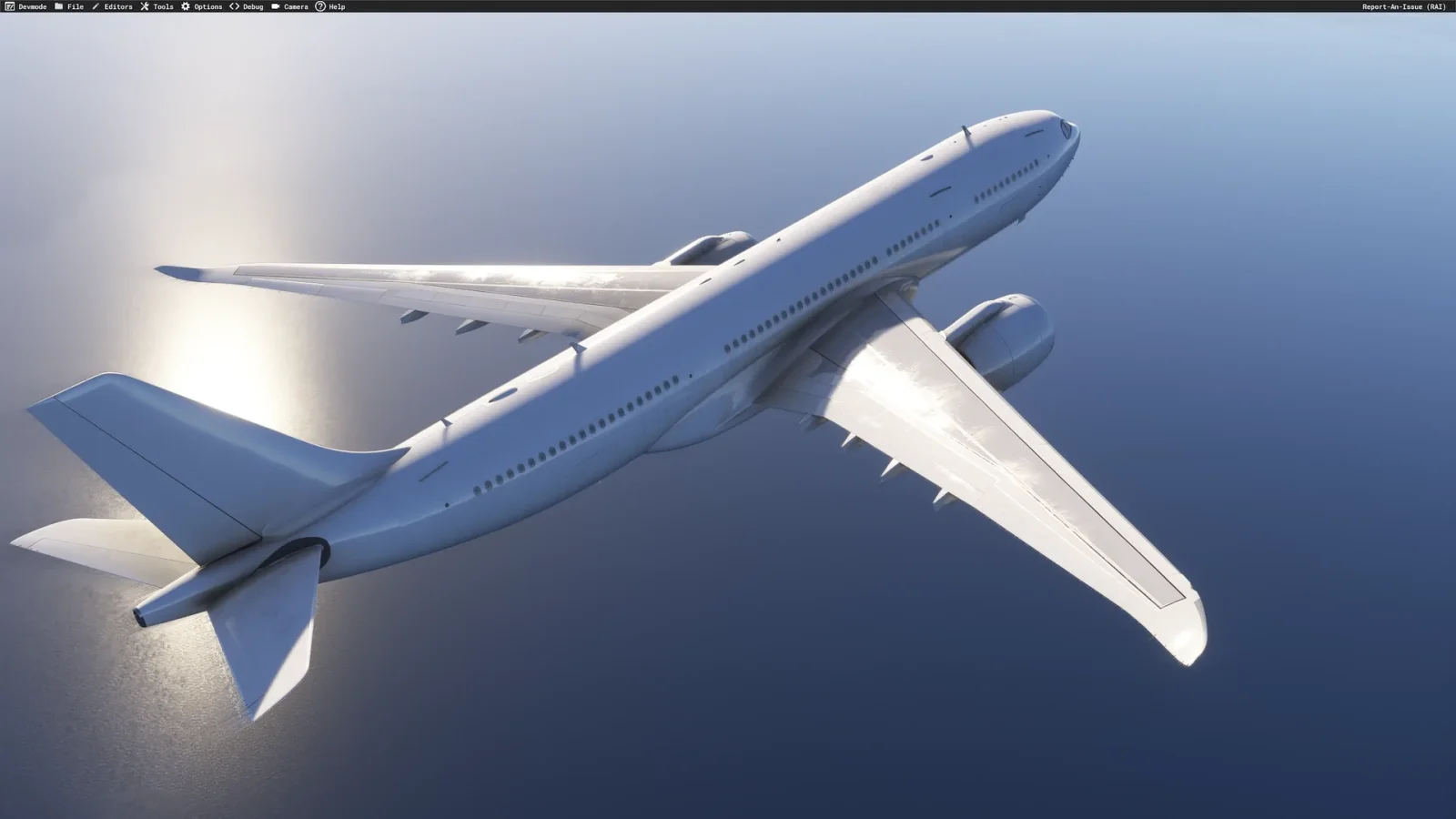







Following the Synaptic A220 has meant piecing together fragments: a trailer here, a booth demo there, a development update in between. Last night’s stream on the official Microsoft Flight Simulator Twitch channel changed that. For the first time in the project’s five-year history, the aircraft flew a complete public flight, from cold and dark in Zurich to a hand-flown RNP-AR approach into Innsbruck. And along the way, the team from Synaptic and iniBuilds answered questions this community has been asking for a long time. If you missed it, and given it ran opposite a certain football match, many did, here’s what we now know that we didn’t yesterday.
The stream featured Chewwy, MSFS Community Manager, and Steve, head of community and QA at iniBuilds, alongside Harsh, project manager and artist at Synaptic Simulations, and Shaye, systems programmer at Synaptic.
Release is “not long” away
No date, no price. The team said upfront that release information was not on the agenda, so anyone hoping for a launch announcement came away empty-handed. But the closing moments were telling. “Not long,” said Steve, before immediately clarifying, with a smile you could hear, “I didn’t say soon.”
This was a showcase hosted on Microsoft’s own channel, the kind of platform typically reserved for products close to shipping, and the team confirmed a deep-dive tutorial video will arrive before launch. Stack that against the summer 2026 window we covered on the new Synaptic website last week, and the window for speculation is getting narrow. Summer doesn’t last forever.
Launch day now has a defined shape, including what’s missing
This was arguably the most useful part of the stream for anyone planning a day-one purchase, because the Q&A was quite specific about scope.
Confirmed for release: the airport moving map, which the team says is being optimized right now, GSX integration with a config already made, full SimBrief uplink both in the FMS and the EFB, Navigraph charts rendered directly on the flight deck displays, Lido chart integration on MSFS 2024, a paint kit for community painters, and time compression support up to 4x. The aircraft launches on both MSFS 2020 and 2024, and the team describes feature parity between the two as very similar, walkaround mode aside.
Not at release: the weather radar, which the team says is held back by how the A220’s unusual azimuthal map projection interacts with the simulator’s weather data access, and scenario-based failures, meaning you won’t be able to trigger an engine failure from the EFB at launch. There is a consolation on that second point, though. The circuit breaker system is deep enough that you can pull breakers yourself, physical and virtual, and watch authentic non-normals cascade across the EICAS, something the team demonstrated live by killing displays and brake systems mid-flight.
And one firm no: Hoppie CPDLC is not planned at all. Instead, one of Synaptic’s developers is building a new CPDLC standard in cooperation with SayIntentions, VATSIM and IVAO, with integration planned after release. The team’s view is that Hoppie is old and clunky, so they’re betting on replacing it rather than supporting it.
This is a Bombardier in Airbus clothing, and it flies like one
If one theme ran through the entire flight, it was the developers repeatedly pointing out that the name on the fuselage is misleading. This began life as the Bombardier C-Series, and anyone expecting A320 familiarity is in for a re-education.
The examples kept coming. The A220 uses speed trim rather than Airbus-style pitch stability, so you trim for a speed the way you would in a 787, with your trim speed visible as a bug on the PFD. VNAV descent is a pilot-selected path angle with no cost index logic behind it, and once established on a vertical path the aircraft follows it aggressively regardless of speed, which Shaye summed up bluntly: speed is basically the pilot’s problem. Even the navigation display draws intercept arrows instead of the smooth curved path an A320 pilot would expect, a quirk of the real aircraft that the team has reproduced faithfully.
Then there’s the engine start. The PW1500G geared turbofans motor for around 45 seconds to lubricate and cool before fuel is even introduced, bringing each start to roughly a minute and 45 seconds, and the team has simulated the whole waiting game. Four minutes of sitting on your hands before taxi is, apparently, the authentic A220 experience.
The systems depth shows up in unexpected places
The display modularity got a proper airing for the first time, and it looks like one of the aircraft’s defining features. Formats can be swapped and rearranged across screens almost freely, checklists and charts can live wherever you want them, and the graphical flight planning lets you insert waypoints, holds, direct-to legs and crossing restrictions straight from the map. The electrical simulation runs deep enough that a display reversion demo mid-flight condensed a full suite of flight information onto two remaining screens, and the team noted that circuit breakers aren’t simple on/off switches but carry underlying system logic, mirroring the real aircraft’s control and distribution cabinets.
The sound package from Echo19 also had its moment. The distinctive PW1500G howl is procedurally driven by spool behavior, so an APU bleed takeoff with its slower spool produces a longer, more resonant howl than a normal one.
On the art side, iniBuilds’ cabin work goes further than most airliners attempt. Every overhead bin opens, tray tables fold down at every seat, and the lavatories are fully modeled, including the rear lavatory window some real-world A220s carry. Steve pre-empted the inevitable comment himself: not every operator has it, so no need to write in about Swiss. One caveat: the aircraft ships with a single cabin configuration, with alternative layouts planned for after release, and cabin announcements remain unconfirmed, something the team says it is exploring with its sound partner.
The -100 and ACJ are coming, and they bring extras
The team confirmed the A220-100 and the ACJ business jet will arrive as a separate product after the -300 launches. More interesting is what they bring with them: a fully modeled avionics bay with physical circuit breakers you can pull, and a head-up display, which is a requirement for the -100’s steep approach capability and will be retrofitted to the -300 as well. No synthetic vision on the PFD, which is true to the real aircraft.
Where this leaves us
Line this stream up against the trajectory of recent months, the final testing announcement in March, the “definitive” trailer at FSExpo, the summer window on the official FAQ, and now a complete public flight on Microsoft’s own channel, and the direction of travel is hard to miss. The two unknowns are the same as last week: an exact date and a price. Neither came last night. But “not long,” said on a Microsoft broadcast in mid-July, with a pre-release deep-dive video still to come, suggests we won’t be waiting much longer to find out. As always, we will have it here the moment it firms up.