




When MSFS 2020 launched, it didn’t just attract the existing sim community: it brought in an entirely new wave of people who had never seriously engaged with flight simulation before. Some came for the scenery, some for the challenge, and some because they’ve always had a thing about aviation but never found an accessible way in. MSFS 2024 kept that momentum going, and today the sim has an audience far broader than at any point in its history.
The thing is, a lot of those newcomers (and plenty of long-time simmers too!) fly without a solid grounding in how real aviation actually works. And that’s completely fine, of course. But for those who want to go deeper, who want to understand why the procedures exist, or why a real pilot does things in a specific order, having good resources that have been put together with care and attention is a must.
Navigraph Academy is probably the best answer to this, and it’s free. The Virtual PPL is really impressive. It’s well-structured, well-produced, and covers the fundamentals of powered flight in a way that’s both accessible and in-depth.
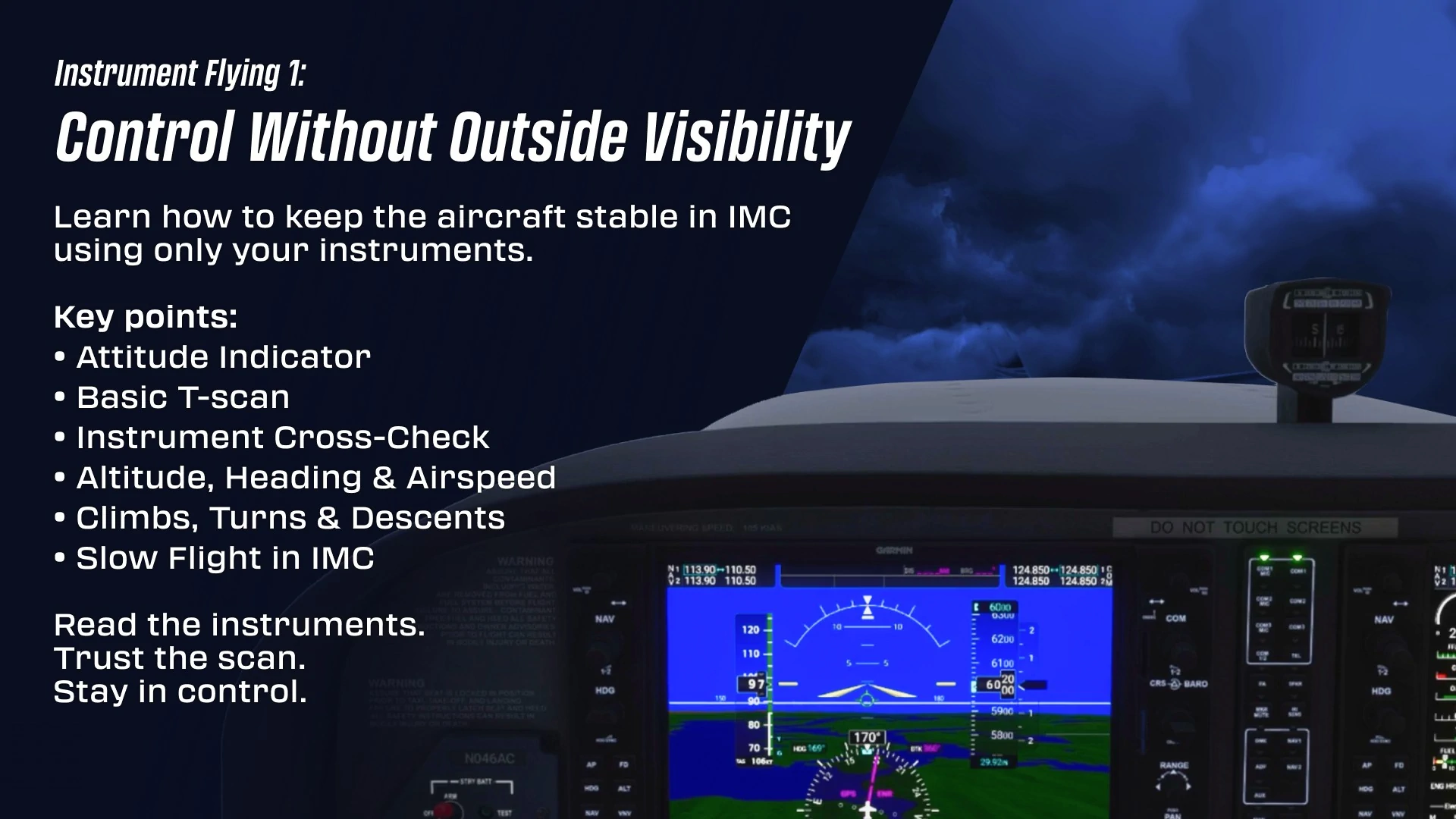
Today, Navigraph is expanding the platform with its second course: Instrument Flying.
Where the Virtual PPL teaches you to fly by looking outside, IFR training is about flying when you can’t. Low clouds, rain, poor visibility, situations where the horizon disappears and where spatial disorientation becomes a real risk if you don’t know what you’re doing. This is the territory the new course covers, across three structured lessons that take you from the basics of instrument control all the way through to flying a full ILS approach down to minimums.
The first lesson, Basic Instrument Flying, introduces the T-scan methodology, which is the disciplined technique real-world pilots use to keep their eyes moving across the instruments. The artificial horizon takes centre stage. The course explains that pilots should be referencing it around 90% of the time during IMC flight, with short glances to the other instruments to confirm that what they’re flying is producing the results they expect.
The second lesson moves from the training area to actual IFR enroute navigation, using the Garmin G1000 and Navigraph Charts together to plan and fly a cross-country route with published minimum safe altitudes, RNAV waypoints, and airways.

The third and final lesson covers ILS approaches, which is one of the most satisfying things you can do in a flight simulator when done properly. The course explains how the localiser and glide slope signals work, how to read a Jeppesen approach chart from header to minimums table, and how to fly the full procedure from the initial approach fix down to decision altitude.
Alongside the new course, Navigraph is also rolling out an upgraded live tracking and post-flight analytics system within the Academy. Users can now follow their training flights on a moving map in real time and review detailed performance data after completing each lesson.
Completing the course and passing the exam earns you a Navigraph Academy Instrument Qualification, something to brag about online or wave in front of your friends. All you need is a Navigraph account, which is also free to create.
The Instrument Flying course is available now at academy.navigraph.com.