





Miltech Simulations is back with the second dev blog for its upcoming MH-60 helicopter for Microsoft Flight Simulator, and while we’re still a few weeks away from release, this update offers a detailed look into the aircraft’s systems—especially the avionics, navigation, and autopilot. It’s a big leap from the project’s initial announcement back in February and builds directly on what we learned in the first blog.
We’re now firmly in Early Beta, and while there’s still no official release date, Miltech is giving simmers a clear picture of what to expect when the MH-60 eventually lands in the sim.
Let’s start with the avionics. Miltech is building the MH-60’s cockpit using the Block I MH-60S U.S. Navy manuals as the primary source of reference. These systems are being applied across all three planned variants (Sierra, Romeo, and Jayhawk) using a common digital cockpit, even though the Jayhawk—known in U.S. Coast Guard service as the MH-60T—actually uses a completely different avionics suite in real life.

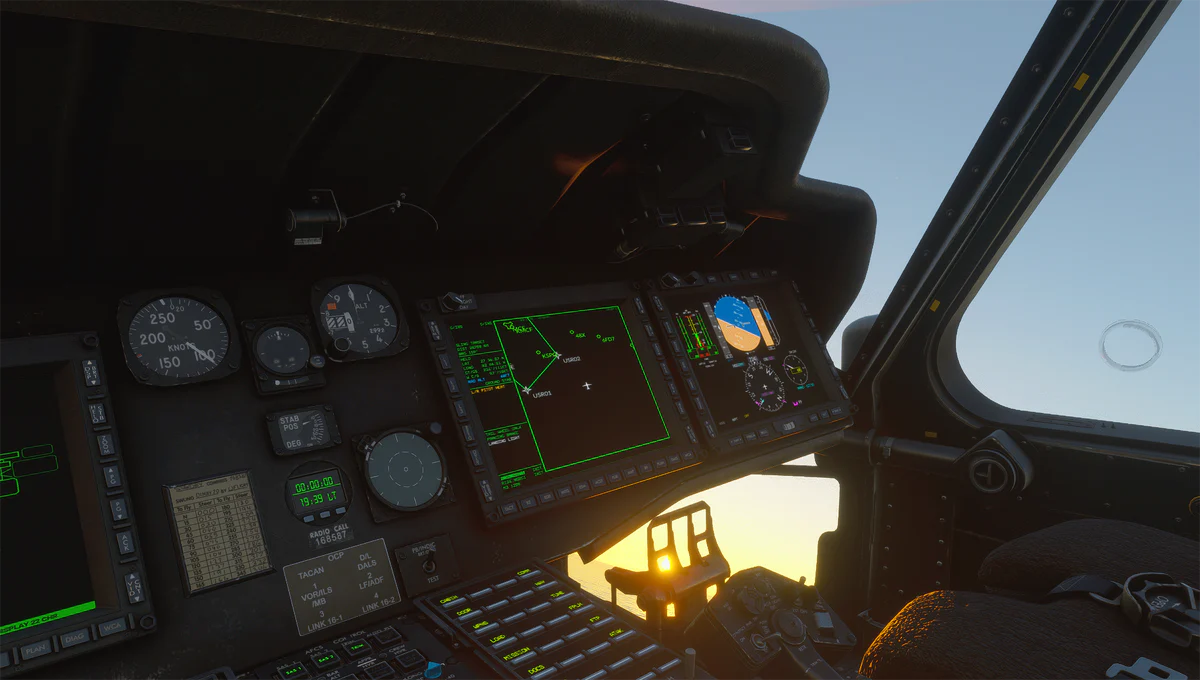
Miltech says it had to omit the Coast Guard’s CAAS (Common Avionics Architecture System) in favor of consistency and feasibility. So, all variants in this release will share the same base layout: two Flight Displays (FDs), two Mission Displays (MDs), and two Keysets.
- The Flight Displays provide flight data like engine info, artificial horizon, HSI, and hover parameters. Inputs like barometric pressure and heading are set directly on the screen using bezel buttons and a Universal Control Knob.
- The Mission Displays are focused on, well, missions—routing, maps, FLIR imagery, system diagnostics, and aircraft warnings. Miltech admits this part is tricky since much of the real-world MD functionality is classified. Their approach is to extrapolate and approximate—especially for the FLIR system, which faces some technical limitations inside MSFS. Still, they say it’ll go well beyond a simple synthetic view.
- The Keyset acts as the central input hub. From it, simmers can control radios, weapons, navigation, ATAK functions, and even manage loadouts like Hellfires, torpedoes, SAR equipment, or external tanks.
It’s a layered, functional cockpit—designed to be immersive without being locked behind inaccessible real-world tech.
If you’re used to flying SIDs and STARs, this helicopter might feel like a different world. Naval helicopters like the MH-60 don’t typically operate under standard IFR routing. Instead, coordinate-based navigation is the norm, usually with help from ground mission planning systems.
To replicate that, Miltech is bringing back its INS Planner, a web-based tool originally created for the M2K-C, now reworked for the MH-60. This lets you build and sync flight plans with the aircraft over the network—effectively simulating a mission cartridge being loaded into the aircraft’s systems.
Here’s how the full nav suite stacks up:
- INS Planner (web-based) for coordinate entry and syncing
- Tablet integration with the FS24 EFB for easy in-sim planning
- Manual entry of FTP waypoints via the Keyset
- Programmable search patterns like expanding squares or parallel sweeps
- Support for VOR, ILS, TACAN, and ADF
- SimBrief integration is on the roadmap, but not expected at launch
Miltech is even trying to make the INS Planner’s UI resemble the dated mission software used in real life—reportedly still running on Windows 2000!
Another core area Miltech is putting a lot of attention into is the AFCS—the Automatic Flight Control System—and the Stability Augmentation System (SAS). Unlike previous helicopters that relied on input-based autopilot logic, Miltech’s new approach bypasses control conflicts and avoids drift over time by using internal trim and acceleration models.
The result? An autopilot system that should feel smooth and dynamic—especially in hover transitions, precision SAR movements, and climb-outs.
Here are the modes modeled from the real aircraft:
- AUTO PLT – For maintaining heading and attitude at different speeds
- RAD ALT / BARO ALT – Holds altitude based on radar or barometric input
- APPR / HOVER – Transitions to a controlled hover, with tunable altitude and drift speeds
- CREW HOVER – For keybind control of fine movements (useful in rescue ops)
- DEPART – A fast climb to cruise speed, hitting 120 knots as efficiently as possible
Miltech notes that the MH-60 does not have LNAV, so it won’t follow a route automatically—flight plans are still crew-managed.
The SAS is also fully modeled, and disabling it will dramatically increase pilot workload. Force Trim, however, won’t be available at launch, although Miltech points to a good freeware solution already available to simulate that functionality.

While most of this blog focuses on systems, there’s also a small update on the mission system, which is one of the MH-60’s most ambitious features. A VERTREP mission at the mini-scenery location of Peñón de Vélez de la Gomera is shown as a teaser, giving us a glimpse of the type of activities simmers can expect.
Miltech reiterates that the mission framework is modular, and intriguingly, says it’s already being evaluated by another well-known developer. That could suggest broader integration across third-party aircraft in the future.
The team is now officially in Early Beta, but they’ve set expectations clearly: there will be no public release date until they’re fully confident it’s ready. In other words, expect a quiet rollout with just a few days’ notice when the time comes.
A same-day release on PC and Xbox remains the goal, but Miltech warns that timing on Xbox depends on Microsoft’s approval process.
Miltech says Dev Blog #3 will cover more on the mission system—arguably one of the most awaited aspects of this helicopter project. Until then, simmers can dig into this latest update for a deep dive into the systems powering what’s shaping up to be one of the most feature-rich helicopters in the sim.